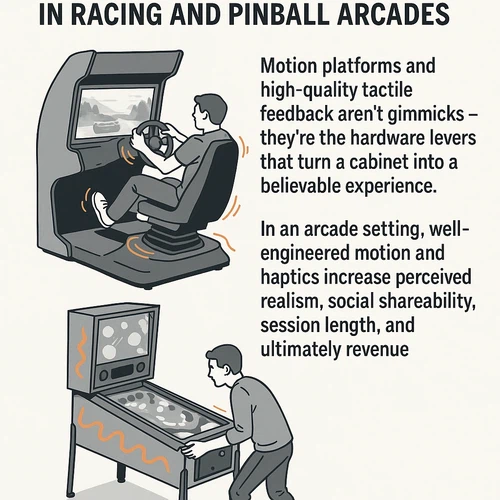
Short answer: motion platforms and high-quality tactile feedback aren't gimmicks - they're the hardware levers that turn a cabinet into a believable experience. In an arcade setting, well-engineered motion and haptics increase perceived realism, social shareability, session length, and ultimately revenue.
What players actually feel (and why it matters)
Players judge authenticity by what their body senses, not just the screen. Good force-feedback tells the player about traction, collisions and surface changes in real time - that reduces confusion and increases confidence, so players play longer and return. High-end wheelbases and motion platforms are used in commercial sims and pro training because the extra tactile fidelity measurably changes behavior and learning.
How feedback and motion change behavior in arcades
- Higher engagement: motion + haptics make moments "shareable" (clips of players reacting), which drives social buzz. Coverage of trade shows like IAAPA repeatedly shows motion rigs as crowd magnets.
- Longer sessions: believable feedback reduces frustration and encourages repeat attempts - that raises spend per visit.
- Better word-of-mouth & bookings: leagues, timed sessions and VIP packages sell better when hardware feels premium.
Hardware priority (what to buy first)
For racing arcades buy in this order:
- Wheelbase / force-feedback system - core of realism. (High priority)
- Pedals & seat ergonomics - accurate input is essential.
- Motion platform (2–3 axis minimum) - adds body cues that screen-only rigs can't deliver.
- Haptics & tactile add-ons (vibration motors, G-seats) - low-cost lift to perceived realism.
For pinball, prioritize robust actuators and seat/bed shakers plus tuned audio to simulate ball impacts and table vibration.
Real examples and research
Modern sim providers show that motion feedback can replicate physiological responses similar to real driving; several operator reports and case studies published around IAAPA and sim-industry sites back this up - motion rigs pull more attention and revenue than static units.
Suggested allocation of CAPEX for a single premium racing arcade cockpit (100% = total unit budget):
- Force-feedback wheel & base: 40%
- Motion platform: 25%
- Seat & cockpit frame: 15%
- Pedals / shifter / controls: 10%
- Integration, audio & installation: 10%
For a premium pinball / virtual pinball cabinet:
- Actuators / haptics (shakers, G-seat): 35%
- High-quality audio & speakers: 20%
- Display & GPU / software: 20%
- Cabinet/frame & motion chassis: 15%
- Integration & install: 10%
Quick operational tips (do this now)
- Tune feedback intensity per-location (mall vs. barcade) to avoid scaring casuals.
- Log plays and watch social clips - if a machine gets shared, you've hit the sweet spot.
- Choose modular hardware so you can upgrade wheelbases or motion later without full replacement.